

Release notes 6.7.0
Table of content
Improvements
Version 6.7.0 introduces self-service tenant and bank account provisioning, extends counterparty support to national clearing codes, and adds AI-powered cashflow forecasting together with MCP-based AI agent integration.
Tenant configuration self-service provisioning
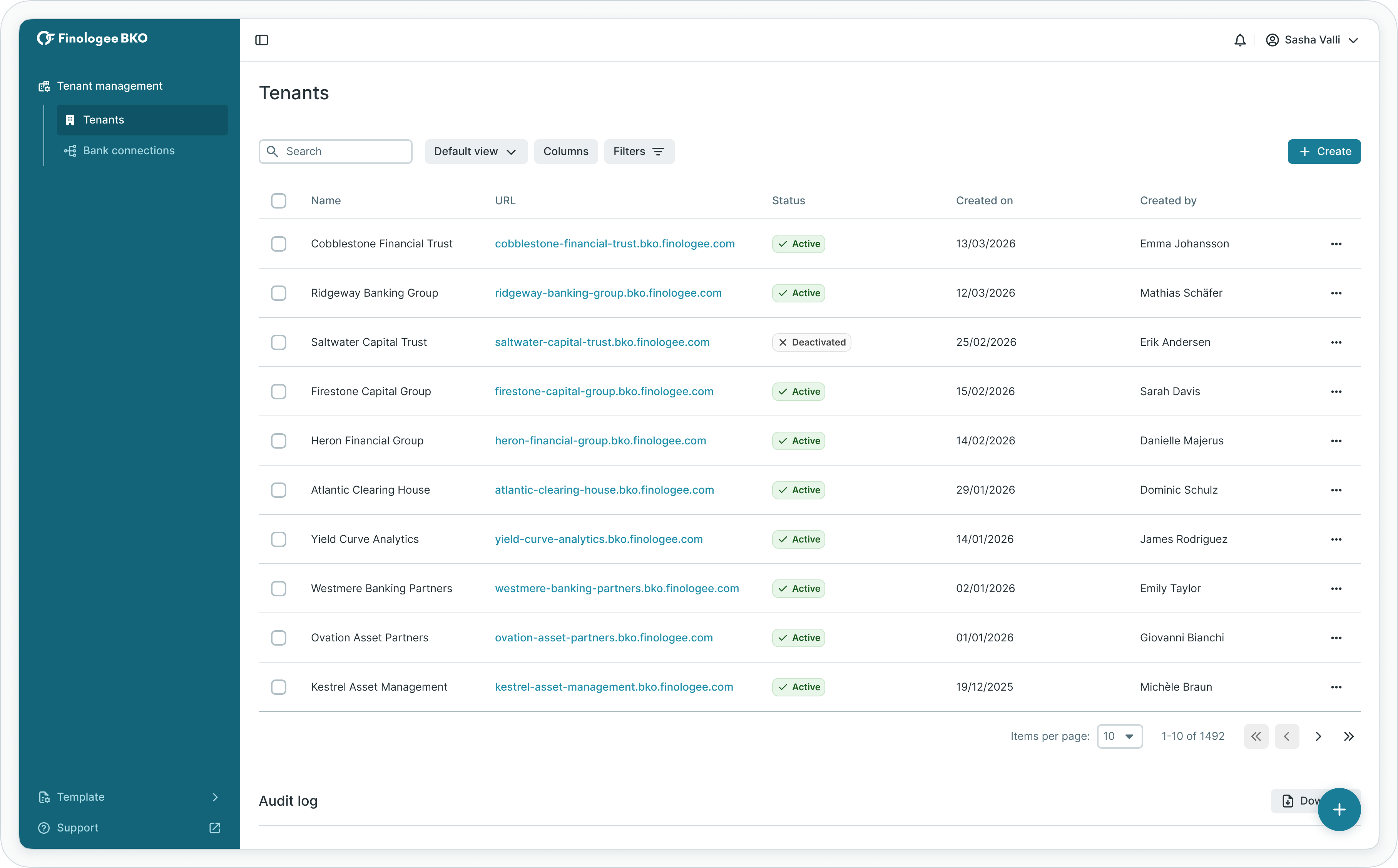
FinologeeBKO introduces template tenants, which serve as a blueprint for creating new tenants. Users with tenant management rights can now create new tenants directly in the UI, using a wizard that replicates roles, rights, payment categories, account groups, and authentication methods from the blueprint template. Provisioning, including schema cloning and identity client setup, runs automatically without requiring database access or manual infrastructure work.
This removes the dependency on Customer Support teams for the creation of a new tenant, benefiting clients scaling the scope when operating a tenant-per-fund or tenant-per-client model with a growing scope of operations. The new Tenants directory will gather all tenants created from a template, with status tracking and an audit trail, and administrators can disable or re-enable them as needed.
Self-service Bank account creation
Users assigned with the right to create an ordering party account can now add new bank accounts to their tenant directly through the FinologeeBKO interface, individually or in bulk, instead of having to submit a request to the Customer success team.
New accounts start in a pending status and become active automatically once bank connectivity is confirmed and the account starts receiving bank statements.
Counterparty support for alternative routing codes
Counterparty creation now supports national clearing codes (such as Sort Codes, ABA routing numbers, and BSB numbers) in addition to BIC, reflecting how domestic payment systems outside the SEPA area identify banks. Users can start creating a counterparty from either an account number or a country selection; entering an IBAN resolves the country and BIC automatically, while selecting a country determines the expected clearing code format for validation. The BIC field is relabeled Bank Code to reflect this broader scope.
This extends counterparty creation to markets that do not use IBANs, such as the United States, the United Kingdom, and Australia, removing the need to look up bank codes through external tools. The same clearing code support applies to the API and bulk upload, and clearing codes are mapped into MT101 and pain.001 payment messages.
AI-powered account cashflow forecasting
FinologeeBKO introduces AI-based forecasting of account balances, addressing a key limitation: a displayed balance reflects only the latest available bank statement and can therefore be several days out of date. The forecast projects expected account balances for the current day and the following business days, shown as a single value or as a confidence interval (downside, base, and upside), for individual accounts or aggregated across accounts.
Forecasted balances appear on the Dashboard and on the Bank account detail page, alongside historical balances. This helps users anticipate cash positions ahead of the next bank statement and plan payments and cash management decisions with clearer visibility. The dashboard forecast is labeled as an AI-based estimate.
MCP server for AI agent integration
FinologeeBKO exposes a Model Context Protocol (MCP) endpoint that lets AI agents such as Claude and ChatGPT interact with the platform using the same authentication, rights model, and signatory-rule approvals as the REST API. The endpoint provides around 40 tools spanning payments, direct debits, cash and accounts, counterparties, and invoicing, and is enabled per tenant through a feature flag.
Because MCP tools reuse the same services as the REST API, the platform's rights model is enforced on every tool call: an agent can only successfully carry out actions the connected user is permitted to perform. Actions that change data are recorded in the audit log in the same way as the equivalent REST API calls, allowing users to delegate repetitive tasks, such as drafting payment batches or reconciling direct debit collections, to an AI agent without bypassing existing approval controls.